The United States' Supersonic Transport (SST) program was initiated by the Federal Aviation Administration (FAA) in 1963. The program aimed for a Mach 2+ aircraft capable of carrying 300 passengers with intercontinental range. The US aimed to outstrip the British Aerospace/Aerospatiale Concorde and Soviet Tu 144 programs through the use of advanced technology and materials. By the late 1960s contracts had been let to prime contractors Boeing (airframe) and General Electric (engines) but the program was four to five years behind the European and Soviet efforts, which had graduated to supersonic flight testing while the US program had yet to pass beyond the mockup stage. In 1971 the slow pace of technical development, environmental concerns, high costs, and questions over the commercial feasibility of the aircraft led Congress to cancel the program.

Showing posts with label SST. Show all posts
Showing posts with label SST. Show all posts
Monday, 19 July 2010
Monday, 5 July 2010
Supersonic Concept Plane Would Shush Sonic Booms

The concept aircraft, envisioned by aerospace company Lockheed Martin, would revolutionize supersonic cruising by relying upon a so-called "inverted-V" engine-under wing configuration, where the engines sit atop the wings rather than beneath, NASA officials said in a statement.
Full article: FOXNews.com - Supersonic Concept Plane Would Shush Sonic Booms
Wednesday, 16 June 2010
Scramjet - Next Generation Planes
A scramjet (also known as supersonic combustion ramjet) represents a variation of ramjet using supersonic combustion. Just like the ramjet, the scramjet has a constricted tube and the air is compressed using a high speed. There is also a combustion chamber with fuel that gets combusted. Also, the nozzle exhausts the jet leave at a very high speed, much higher than the inlet air.
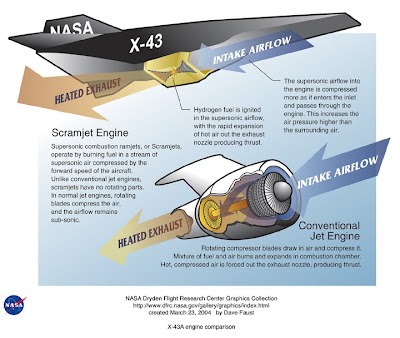 The commercial engines of aircrafts use the compressor to take the air and squeeze it into the engine and then spray that fuel into the air. After that ignition starts. In this case the great thing is that very few parts are needed for the whole process. There is no need to a high speed turbine like the one used in turbojets. There is a minimum functional speed required. Also, the scramjet needs supersonic airflow to pass through the big engine. There are also much recent models that use booster rockets to get the velocity.
There have also been made some projections on the top speed and that can reach Mach 24.
Right now the USA Air Force has the SR-71 Blackbird , that can reach close to Mach 3.4. Also, the rockets used on the Apollo Program reached Mach 30+.
Also, it is important to know that the scramjets have complexity and weight issues. This is why few suborbital tests with scramjets have been done. This is because no flown scramjet has survived an actual flight test. Many of the needed parameters are still unclear and the research is taking a long time.
This led to many claims from both of the sides working on this. Pioneers like Jim Oberg and Henry Spencer have named orbital scramjets "one of the hardest manners to reach the orbit", or they used the term 'scramjets' to refer to the applications.
Read more about scramjet and next generation supersonic planes, Visit... Scramjet.
Article Source: http://EzineArticles.com/?expert=Sanjay_Kak
has a constricted tube and the air is compressed using a high speed. There is also a combustion chamber with fuel that gets combusted. Also, the nozzle exhausts the jet leave at a very high speed, much higher than the inlet air. needs supersonic airflow to pass through the big engine. There are also much recent models that use booster rockets to get the velocity.
There have also been made some projections on the top speed and that can reach Mach 24.
Right now the USA Air Force has the SR-71 Blackbird
, that can reach close to Mach 3.4. Also, the rockets used on the Apollo Program reached Mach 30+.Also, it is important to know that the scramjets have complexity and weight issues. This is why few suborbital tests with scramjets have been done. This is because no flown scramjet has survived an actual flight test. Many of the needed parameters are still unclear and the research is taking a long time.
This led to many claims from both of the sides working on this. Pioneers like Jim Oberg and Henry Spencer have named orbital scramjets "one of the hardest manners to reach the orbit", or they used the term 'scramjets' to refer to the applications.
Read more about scramjet and next generation supersonic planes, Visit... Scramjet.
Article Source: http://EzineArticles.com/?expert=Sanjay_Kak
Thursday, 13 May 2010
Can SSTs Be Made Quieter? / JAXA Advancing In Development Of High-Speed Commercial Aircraft

The Supersonic Transport Team of the Japan Aerospace Exploration Agency (JAXA) is aiming to reduce the thundering roar of such aircraft, a challenge that weighed on the Concorde, a civilian supersonic aircraft jointly developed by Britain and France.
Full story: http://www.yomiuri.co.jp/dy/national/T100508002471.htm
Tuesday, 9 February 2010
Conceptual Design of a Supersonic Business Jet Propulsion System
PDF document with plenty of technical information on the conceptual Supersonic Business Jet. Makes interesting reading if you are into numbers!
Click Here For PDF Document
Monday, 4 January 2010
Post Production Use Of The Tupolev TU -144
 Although its last commercial passenger flight was in 1978, production of the Tu-144 did not cease until six years later, in 1984, when construction of the partially complete Tu-144D reg 77116 airframe was stopped. During the 1980s the last two production aircraft to fly were used for airborne laboratory testing, including research into ozone depletion at high altitudes.
In the early 1990s, a wealthy businesswoman, Judith DePaul, and her company IBP Aerospace negotiated an agreement with Tupolev and NASA, (also Rockwell and later Boeing). They offered a Tu-144 as a testbed for its High Speed Commercial Research program, intended to design a second-generation supersonic jetliner called the High Speed Civil Transport. In 1995, Tu-144D [reg 77114] built in 1981 (but with only 82 hours and 40 minutes total flight time) was taken out of storage and after extensive modification at a total cost of US$350 million was designated the Tu-144LL (Russian: Летающая Лаборатория — where LL is an abbreviation for Flying Laboratory). It made a total of 27 flights in 1996 and 1997. In 1999, though regarded as a technical success, the project was cancelled for lack of funding.
The Tu-144LL was reportedly sold in June 2001 for $11 million via online auction, but the aircraft sale did not proceed after all — Tejavia Systems, the company handling the transaction, reported in September 2003 that the deal was not signed. The replacement Kuznetsov NK-321 engines (from the Tupolev Tu-160 bomber) are military hardware and the Russian government did not allow them to be exported.
At the 2005 Moscow Air & Space Show, Tejavia founder Randall Stephens found the Kuznetsov NK-321 engine on display, and the Tu-144LL rusting on Tupolev's test base at the Gromov Flight Test Center. In late 2003, with the retirement of Concorde, there was renewed interest from several wealthy individuals who wanted to use the Tu-144LL for a transatlantic record attempt; but Stephens advised them of the high cost of a flight readiness overhaul even if military authorities would authorize the use of NK-321 engines outside Russian Federation airspace.
The last two production aircraft remain at the Tupolev production plant in Zhukovsky, reg 77114 and 77115. In March 2006, it was announced that these airframes had been sold for scrap.Later that year, however, it was reported that both aircraft would instead be preserved. One of them could be erected to a pedestal near Zhukovsky City Council and TsAGI or above the LII entrance from the Tupolev avenue.

Subscribe to:
Posts (Atom)